Incredibly frustrated. That’s the least colorful, most boring way to describe how I, and probably you, feel right now. So many of us probably want November 9 to come even more than we want a particular candidate to win at this point, because we are tired of it all. We are tired of the divisiveness, tired of the platformless, ideologically shallow debates and campaigns, and we are ready to move on. Well, can I burst your bubble? It isn’t going to get any better, although it could, and I am going to offer some specific ways how. But it does not all depend on whom we choose for president. Our federal government was created with three branches that share power equally, with certain rights and responsibilities to make sure the other branches do not get more powerful. But we have placed so much weight on the presidency at the cost of Congress and to the abuse of the Supreme Court.
Our future levels of frustration, cynicism, anger, and apathy hinge not on our president, but on Congress. And the clearest demonstration of this is through the lens of healthcare. Let’s talk about the Affordable Care Act (Obamacare). Healthcare plans through the Exchange Market are rising by 22% for 2017, continuing a trend that many naysayers had predicted when it passed in 2010. Private or employer-based insurances are increasing as well, and it is getting too expensive for some people to buy or even use their insurance. High deductibles discourage people from actually using the insurance they are working hard to pay for, or people are stuck with a tax by the IRS for not having purchased health insurance.
On the other hand, insurance companies are prohibited from denying someone based on a preexisting condition, which yes, includes pregnancy. Women cannot be charged a higher premium rate. And dependents can be covered under their parents’ plans until they are 26 years old. Many people who were too sick or too poor to get health insurance can get it now. Clearly we have created something that has made lives better for millions while gradually making it harder for others at the same time.
Republicans are rejoicing at the failures of the Affordable Care Act. They have voted to repeal the act more than 60 times in the house, and GOP leaders have not been very warm to the idea of improving the Act, but favor completely abandoning it instead. Politically, the idea of Congress working together to make the necessary improvements on the law is suicidal for the politicians. And yes, improvements are needed. Lawmakers knew that from the beginning. Without fully supporting that claim with loads of facts, let’s at least look at how the bill became law:
The House and Senate were both dominated by Democrats, but they had different versions of the Affordable Care Act. The plan was to work out the imperfections and then both houses would pass an improved version of the bill to President Obama. They had a strong majority, and it was a filibuster-proof in the Senate. They could do what they want, and they did it all without much, if any, Republican input. Clearly the Republicans are still bitter about that. I would say they are more bitter about that than they are about the ideological differences in the law. With the passing of Ted Kennedy and the special election in Massachusetts that brought Republican Scott Brown to the Senate, the Senate was no longer filibuster-proof, and the Democrats had to act fast. The House mustered enough support to pass the Senate’s version, which went to Obama’s desk to become Obamacare.
Democrats snubbed the Republicans and rejoiced at their victory, and the Republicans have held on to the bitter resentment of that moment, and have openly sworn to make Obama’s presidency a failed experiment. (I’m paraphrasing Mitch McConnell). With Obama’s political capital spent within his first two years, not much major legislation has come forward since. It has been political stalemate, and the American people have been held hostage by partisanship, as body shields for the politicians’ gain.
As we can see today, people are being impacted both positively and negatively by this law. Time and again, Clinton has said that we can keep the good while revising what does not work. Looking more closely at what doesn’t work could give us insight as to whether is can actually be improved, or if we really do need to throw it all out as Trump advocates. I don’t know everything about the law, but many of us know people who have benefitted from it and people who are are experiencing financial hardship because of it.
This is what we know: Premiums are increasing, deductibles for the most affordable plans are almost unethically high, and people who opt not to buy insurance (perhaps because they are healthy) are stuck with an unaffordable penalty or tax. Can these problems be addressed while saving the protections for those who are sick, poor, or unemployed dependents under the age of 26? I think so. I cannot really advocate many specific solutions, because I don’t know all the details, but proponents for Obamacare that recognize the need to revise it range from a nationalized or universal system (opt-in or otherwise) to simply encourage more competition through interstate regulation (which was left out of the original Act). For example, what would happen if the rates boundaries between states came down and insurance companies had to deal with more competition? It is an idea floated by Republicans but has not been seriously discussed by Congress. Nonetheless, the most ethical choice is to protect those who are newly protected under the Affordable Care Act while seeing how it can do more for others.
It is complicated, and yes, people or businesses could be adversely affected with future revisions and amendments to the law, but we can keep getting better while retaining the good we have gained.
Arguments for reverting to the old system and allowing the poor or sick to take advantage of the system that had been in place are insensitive and unethical. Advocating for some to scrape the bottom of the barrel because we personally don’t need health insurance or because we are not hurting in that system forget the added costs that that system incurred. The problem is not going away until we are willing to address it. Erasing the law from the books does not address it, and vaguely saying we need to get premiums down does not address it. Real decisions, hard decisions must be made and advocated in Washington, D.C. and state legislatures.
Part of the problem has been antagonism on both sides to force the other side to endure instead of improve. Some states have refused to do what they can to insure their citizens, and the federal Government has yet to offer an amendments to the law of any kind.
This needs to change on January 21. If Trump wins, it most likely means that there is a Republican House and Senate. This might make some of you happy, but that means that Obamacare is completely repealed with no alternative in place. (Trump has made no detailed plan of its replacement.) Progress on environmental policy will be reversed, foreign trade could stall, and we will get our wall. If Clinton wins, we will still have a Republican House and possibly a Democratic Senate with a very weak majority, and it will be business as usual. In this case, Republicans will wait out the Affordable Care Act until its death and claim victory. We would not achieve a functioning immigration policy, energy policy, or a plan for improving infrastructure, and President Clinton will resort to executive orders to get anything accomplished in her presidency. Sound familiar?
But both scenarios can be avoided. There is much to gain from collaborating with the opposition, and we can achieve that throughout the next four years.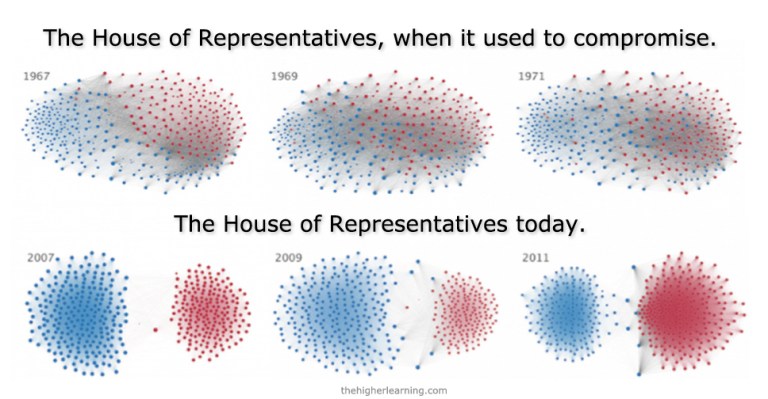
First, we should avoid electing candidates who are campaigning on intolerance and no compromise. This country exists as a result of compromise. It is in our political identity, and to argue otherwise is shortsighted and simply un-American. Compromise, as long as it is meant to solve a problem (Ex. The Great Compromise) and not delay the problem (Ex. The Three-fifths or Missouri Compromise) can help move the country forward and make great strides in policy formation. One more example of this is when we first ratified the Constitution. Many were unhappy with the original text, but the argument to adopt the Constitution and then figure out what needs improved won out over scrapping it altogether and starting afresh. It was the only way leaders could more or less get the ball rolling on a functioning government.
Second, we should pressure our elected officials to avoid blind partisanship. This has become the modus operandi since Johnson signed the Civil Rights Act in 1965, and it is time we push our leaders to reverse the trend. Representatives should weigh the interest of their constituents (all of them), with the interests of their state, and the interest of their nation. There have been times representatives voted on laws that were counter-intuitive to one of the three, but upheld the other two. Nowhere did I mention they should vote in the interest of their party. I know this seems overly idealistic, impractical if not impossible, but it is not impossible. It is a choice to be made. Liberal Republicans and Conservative Democrats could form an additional caucus in Congress to promote a balanced agenda. PACs and Super PACs could push forward candidates who were willing to consider what is best for the country and its citizens, because that, in the end, is what is best for the political parties.
 Unbreaking the News