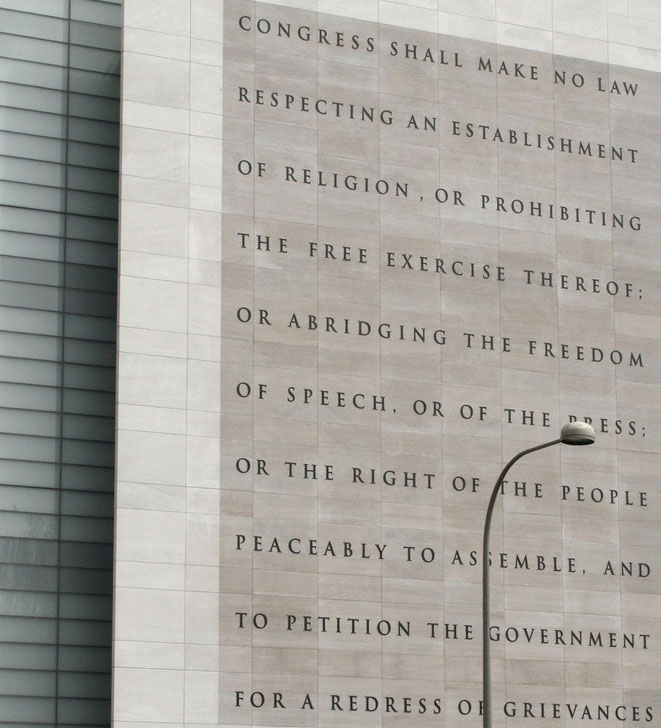
The fewer dogmas, the fewer disputes; the fewer disputes, the fewer miseries: if this is not true, then I’m wrong.
Religion was instituted to make us happy in this life and in the other. What must we do to be happy in the life to come? Be just.
What must we do in order to be happy in this life, as far as the misery of our nature permits? Be indulgent.
It would be the height of folly to pretend to improve all men to the point that they think in a uniform manner about metaphysics. it would be easier to subjugate the entire universe through force of arms than to subjugate the minds of a single village. . .
– Voltaire, “Virtue is Better than Science” from A Treatise on Toleration (1763)
I often joke that I have a love affair with the U.S. Constitution. That is quite the hyperbole, but, if given a copy of the Constitution, I can easily hole myself up somewhere for who knows how long reading and rereading phrases, placing emphasis on this clause or another just to change the meaning of a sentence. And if you give me a good Supreme Court case that pokes, prods, and challenges our conventional understanding of the Constitution, you have 220% of my attention, and I’m a kid in a candy store.
So, here I get to geek out a little bit as I preface this post.
One of those court cases is Schenck v. United States (1919). Charles Schenck distributed literature during WWI that challenged the U.S. entry into the war and discouraged would-be soldiers from enlisting. Citing a recently passed law (Espionage Act of 1917), the U.S. government accused Schenck of criminal activity by attempting to obstruct military recruitment. The Supreme Court unanimously agreed. Here is a little excerpt from Justice Oliver Wendell Holmes, Jr. (emphasis added):
“We admit that in many places and in ordinary times the defendants in saying all that was said in the circular would have been within their constitutional rights, but the character of every act depends upon the circumstances in which it is done. […] The most stringent protection of free speech would not protect a man in falsely shouting fire in a theatre and causing panic. […] The question in every case is whether the words are used in such circumstances and are of such a nature as to create a clear and present danger that they will bring about the substantive evils that Congress has the right to prevent” (Irons 265-66).
As a side note, this law that was upheld by the Supreme Court has continued to stir controversy for nearly 100 years. However, neither this law nor this case are the focus of this post. I’m using it as an example of our freedom of expression being limited for what is to be believed to be the protection of society and its citizens. I want to disagree with this court ruling along with any convictions that have come from it. And honestly, I do disagree with the Schenck ruling, simply because that ruling would not manage to stand the test of time. I can’t even see this case making it to the lowest level of the courts in 2015. However, in other instances, common sense serves as a check and a balance to my idealism. Of course, there are times when our freedom to share our ideas or information that we should not be sharing can cause a “clear and present danger.” So the question posed is this: “Who should regulate our freedom of expression?” Or any freedom, for that matter.
In my last post, I mentioned the freedom of expression that is so much a part of modern French identity that it allows also for a freedom to insult the absurd and to offend the rule maker. In the days that followed that post, there has been an abundance of “#jesuisCharlie.” And with that came a debate as to whether many who advertised their alliance understood or had even read the pages of the magazine. Many began to explain why they really do not want to align themselves with the ideology that supports a right to “offend.” And today, an article has shared Pope Francis’ opinion on the matter. Clearly there are two separate points being made here: 1) a right to expression that should never be disrespected and 2) a natural right to be respected. Point number one is a given and, from a Western point of view, is inarguable (though it is frequently explored and clarified as is seen in the court case provided above). But what is the basis for point number two? I mean, there is no legal provision to protect our right to respect. So how can you even begin to challenge whether we have a right to respect or not? If there is no law regulating it, does that mean our dignity and right to respect are fair game and free to be snatched, abused, and yes, disrespected?
In some camps, tolerance is a swear word. It is sometimes tied up in acceptance, and when they are intertwined, we can find ourselves unable to tolerate because we cannot accept. My favorite line in Voltaire’s quote stated above is when he asks, “What must we do to be happy in the life to come?” The answer—“Be just”—is a simple one.What does justice look like when we are threatened not to depict the image of a sacred prophet of a religion to which we do not adhere? What does justice look like when our fellow citizens insult our beliefs and one of the things most holy to us in order to prove a point? It’s tricky.
This goes beyond Charlie Hebdo. An article from The Economist reminds us that freedom of expression is being challenged in other Muslim nations as we speak. The author cites a Muslim academic who opines that the Muslim faith values and accepts religious tolerance, but within limits. Governments can be challenged, according to his interpretation, but not the Faith. There is a fine line between “sedition and heresy.” Respect for faith and God transcend any belief or value in freedom of expression. This isn’t stated as a mandate here: It’s clarified as an FYI, just as it is in the original source.
Likewise, there are often conversations in the Christian West about being tolerant and placing significant value on our right to free speech and expression. And yes, this group also struggles to find a line that respectfully allows freedom and devotion to the faith. Where does tolerance become a betrayal of beliefs, and when does devotion become hate or bullying or marginalizing?
Who should regulate our freedom? Are we free when our freedom is limited? I get a little rebellious when someone tells me I cannot do something that, in my eyes, seems perfectly safe. Honestly, I can understand Charlie Hebdo’s editors’ point of view. I don’t like being told what to do. I don’t like having my freedom taken away from me. But what about this: Are we still in a position of freedom when we choose to limit our own freedom, out of respect, of love, of tolerance, of peace? I think we are. I think that is what many people are beginning to say as a healthy compromise between Charlie Hebdo and offended believers. But it is not a compromise. It speaks volumes to limit your own freedom, out of freedom—we speak love and value for one another every time we do so. John Locke posited that we are born with a natural right to liberty. If that is so, rules or not, we are free, and only we surrender our freedom. With that in mind, I think it is ok, perfectly appropriate actually, to surrender my freedom in a moment of respect. Be just.
Source: Irons, Peter. A People’s History of the Supreme Court. Pengiun: New York, 2006.
 Unbreaking the News